

Home » How to prepare for the unthinkable

How to prepare for the unthinkable

“The Chinese use two brush strokes to write the word ‘crisis.’ One brush stroke stands for danger; the other for opportunity. In a crisis, be aware of the danger–but recognize the opportunity.”― John F. Kennedy

How to prepare for the unthinkable

It’s not your parents or grandparents 1970s oil crisis; it’s worse. Many news wires are asking where the war-driven energy crisis is heading. Does it lead to bigger conflicts? Circumstances are ripe for more stupid mistakes. You can’t just cut off oil supplies from the rest of the world and expect nothing will happen. Because things will happen! As they are by the moment, and superpowers and other nations are being squeezed out of energy supplies. It can crush world markets, usher in deep recessions and rationing, not to mention crazy inflation. This is the perfect storm, one in which inexperienced political idealists in power at any level destroy a balanced yet fragile and often oppositional world.

Many global conflicts, the first two world wars started with a chain reaction of events, the first with the Assassination of a Prince, then one retaliation after another. World War II did involve a chain reaction, but it began more from deliberate aggression than from alliances spiralling instantly out of control.

The world is dysfunctional, and it takes diplomacy to function amid differences. We need level-headed leadership and reasoning.

A fear monger’s view may have us believe that the business world in a few weeks may adapt to a war mindset, one with technology and the public in the bunkers of their family rooms and basements, fear streaming news looking for hope and an end to a nightmare scenario that hasn’t happened yet.

But let’s say the fear monger is right, how does business prepare for such an event? The current situation is fluid. And planning within businesses starts with abandoning fiction; we are in a war-driven energy shock. How do we deal with it?

How to prepare for the unthinkable requires maturity and experience in dealing with a crisis.

  1. The first move is cash discipline. Preserve liquidity, delay non-essential spending, tighten receivables, secure credit lines before markets worsen, and assume input costs can rise faster than pricing can be passed through.
  2. In an energy shock, margin compression usually arrives before management teams fully recognize it. Reuters reports central banks are already reassessing inflation assumptions because this latest oil shock is altering rate expectations and broader market conditions.
  3. Next is supply realism. Companies should map where they are exposed not just to oil, but to freight, plastics, chemicals, packaging, food inputs, construction materials, and any supplier whose cost base is energy-intensive.
  4. You need leadership to think of potential scenarios, not forecasts. Build plans for a short disruption, a 60-to-90-day shock, and a prolonged conflict. For each case, decide now what gets cut, what gets protected, what inventory must be secured, what customers must be prioritized, and what pricing actions are acceptable.
  5. Communications must become calm, factual, and frequent. Employees, customers, lenders, and suppliers do not need theatre. They need confidence that management sees the risk, has a plan, and will act early. In a fear cycle, silence gets interpreted as drift.
  6. Get out of bad business situations that will challenge your financial resources, which means stores that no longer make sense should be closed. Consolidate resources and offices. All of this would have happened over time, but situations like this accelerate timelines.
  7. Businesses must prepare by shifting from growth to resilience without surrendering strategic clarity. Protect cash. Stress-test supply chains. Pre-negotiate alternatives. Reprice intelligently. Reduce avoidable complexity. And above all, lead with discipline, because in periods like this, the market punishes hesitation faster than it punishes bad news.
  8. Marketing will be different and dynamic, as will growing and sustaining revenue.  Remember, AI is a critical differentiator for those who have already invested in their capabilities. It may be harder if everything costs more or is scarcer.
  9. For everyone else unprepared, understand that simplicity, being nimble,  can also be an advantage at the local neighbourhood level.
  10. Now the unthinkable. Competing in a world without the internet because of disruptions. Open your 1990s marketing books for that scenario.

If the world moves toward broader conflicts, business survival begins with financial discipline, supply chain realism, and leadership that acts before panic becomes policy.

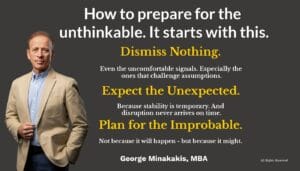
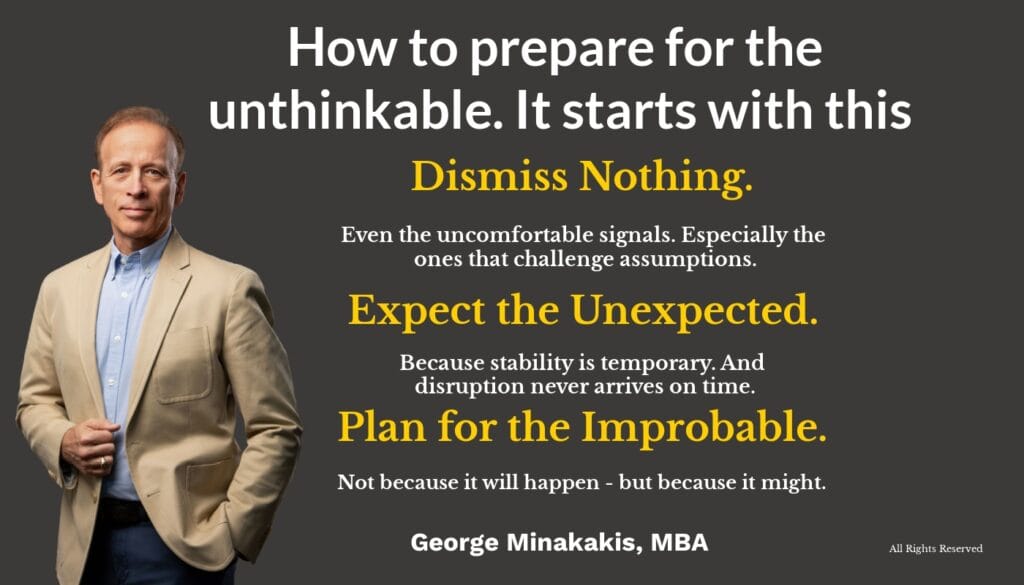
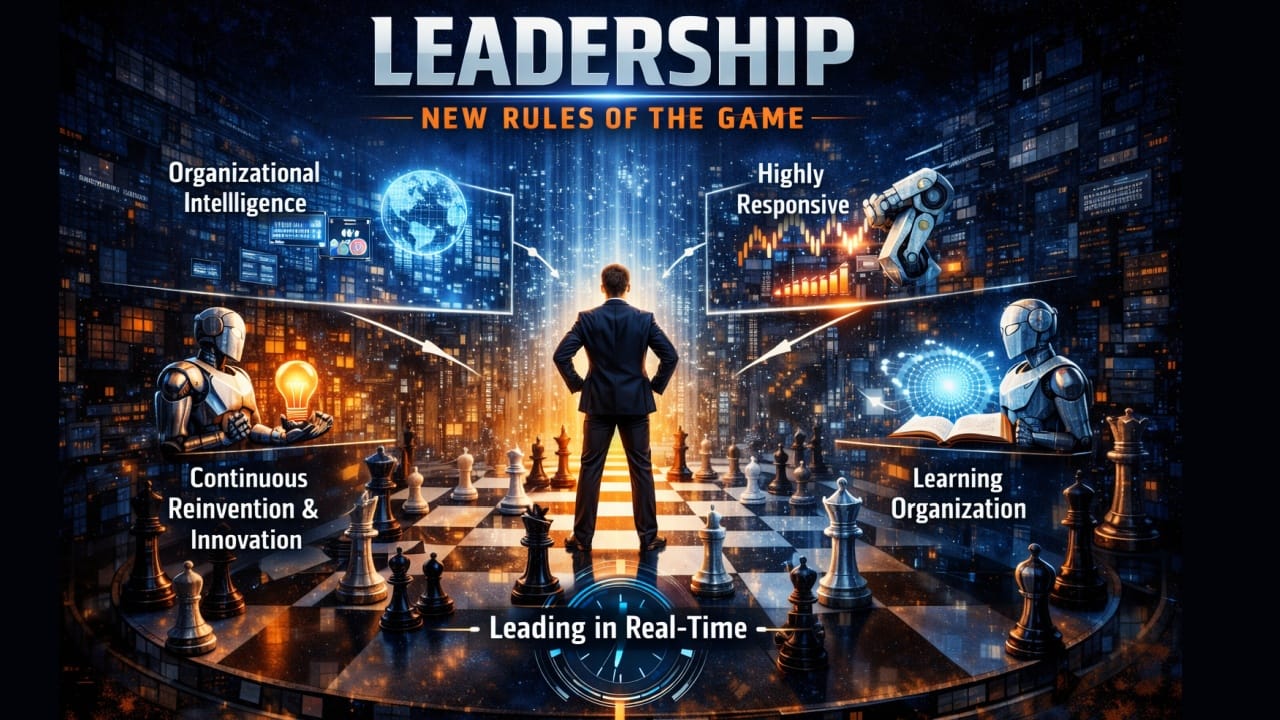
Mature, disciplined businesses and leaders will have already adopted the philosophy below.

George Minakakis is a proven leader, having held senior roles within Fortune 500 companies. CEO of Inception Retail Group Inc. Served on for-profit and not-for-profit boards as a director and chair. He’s the author of four books on leadership and AI. He is also a Municipal Councillor in the Town of Milton.


George Minakakis

CEO | MBA | Author | Advisor | Speaker | Business Visionary

George Minakakis is a Thought Leader and Keynote Speaker. His experience leading, developing, and reviving global brands make him a sought-after Executive Advisor.
Latest Articles

Book George for your next corporate speaking event

Generation-AI: Reimagining leadership, performance, innovation, and customers.

lead the future with George as your executive advisor

Break away with next-generation CEO strategies and innovations.
NEW BOOK RELEASING SOON!
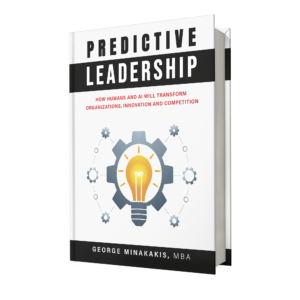
Predictive Leadership: How humans and AI will transform organizations, innovations, and competition.

Executive Advisory

Learn from a visionary leader who consistently elevated consumer-facing brands to top market positions during his tenure.

Speaking Events

Gain critical insights from George's latest talks about reimagining leadership, performance, innovation, and customers.

Media Inquires

Reach out for media inquiries regarding interviews, guest writing, article citations, and more.

Get In Touch.

Use our simple form to reach out and George or a member of his team will get back to you ASAP. Ask about booking a call, or make a media inquiry.