
The most dangerous threats to a brand are no longer only external. They are internal, habitual, and often defended as “how we do things here.” Many organizations don’t collapse because they were outcompeted. They collapse because they were outpaced by reality, and then outperformed by those who acted sooner. They didn’t fight the future; they created it.
Leaders rarely wake up and decide to destroy their brand. They do it slowly, through rationalization. Through comfort with the familiar. Through protecting systems over outcomes, hierarchy over talent, and process over trust. They do it by insisting that complexity is sophistication, when more often it is avoidance.
Here’s the uncomfortable truth: most brand destruction is not caused by a single catastrophic event. It is caused by a pattern of leadership behaviors that quietly weaken belief among customers, employees, partners, and communities. When belief erodes, performance becomes harder to sustain, loyalty becomes expensive, recruiting becomes fragile, and growth loses its resilience.
It may surprise some, but the very essence of this one word often comes wrapped in condemnation. It’s blamed for why things don’t get done, why costs spiral, and why protectionist behavior smothers momentum. Yet it persists because it disguises itself as safety.
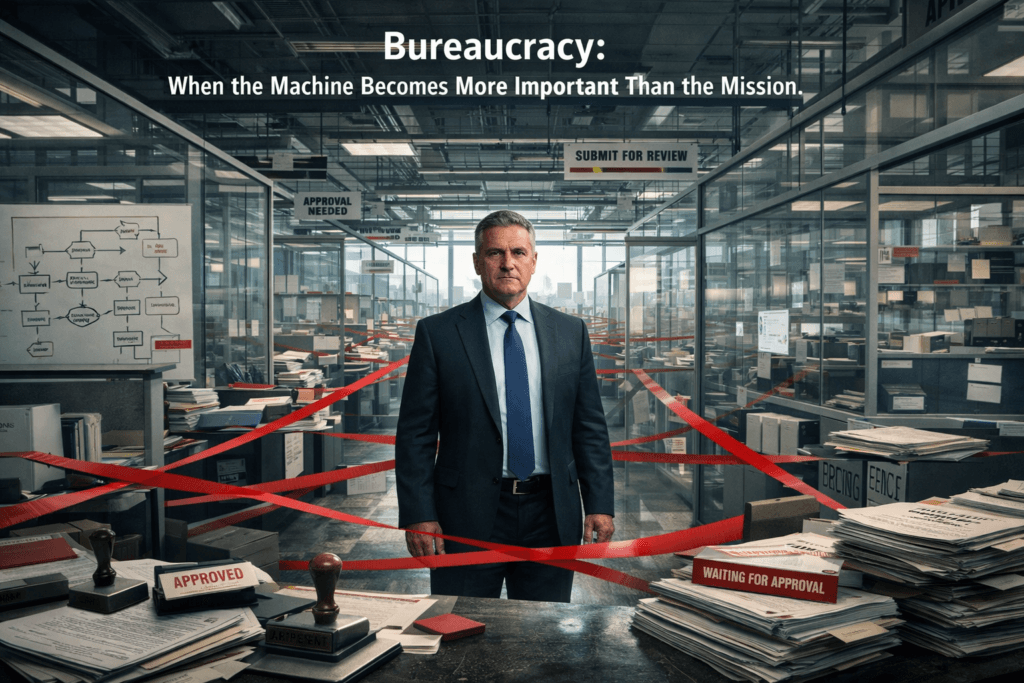
Bureaucracy is not organization, governance, or discipline. Bureaucracy is what happens when process replaces purpose, and the institution begins serving itself. Yes, bureaucracy, like a virus, finds its way into the culture of what might have been one of hope, innovation, and entrepreneurship. Bureaucracy slows organizations down because it prioritizes protectionism first, as a reaction, tearing away at the fabric of what is really important to true business survival. For every major retailer that has failed, I am certain the bureaucracy crept in unnoticed and moved through the organization. It created silos and promoted others based on alignment with those who supported the bureaucracy, rather than challenging it.
You know bureaucracy has taken root when:
Decisions require excessive approvals, yet still produce mediocre outcomes
Meetings multiply while accountability disappears
Leaders defend fiefdoms more aggressively than customers
Risk management becomes an excuse to avoid leadership
Complexity replaces clarity
Customer reality is filtered, delayed, or diluted
Bureaucracy destroys brands in three ways.
First, it slows response time in a world that punishes delay.
Speed is no longer a competitive advantage; it is credibility. Customers interpret slow responses as indifference. Employees interpret them as cowardice. Competitors interpret them as an opportunity.
Second, it trains employees to stop caring.
Bureaucracy teaches capable people that initiative is risky, effort is unrewarded, and ownership is discouraged. Over time, talent either leaves or stays and disengages. Compliance is not loyalty. Compliance is surrender.
Third, it creates leaders who manage procedures instead of outcomes.
Eventually, bureaucracy produces leaders who can navigate internal systems but cannot move external reality. They become highly skilled at internal survival and increasingly irrelevant to external competition.
Fourth, bureaucracy also comes disguised as democratic
It’s a funny thing about bureaucracy: it is so easy to be mistaken for true democracy within. Because it comes with statements from leaders that the approach is sound and will take you into the future, until it doesn’t. Democracy must be continually molded to fit the changing world we live in, and when it doesn’t, it’s no longer a democracy. Business and careers are the same!
Healthy organizations adopt innovative, forward-thinking, and entrepreneurial cultures. These environments are not always comfortable. They are fast-moving, competitive, and demanding. They reward judgment over compliance and progress over permission.
This requires leaders to open the door to discourse—to invite challenge, encourage questioning, and allow people to test assumptions without fear. Organizations fail when they become trapped in an internal orbit, pulled by a gravitational force that serves no customer, no employee, and no future.
Bureaucracy is the antithesis of business success. Within governments, they may exist to minimize risk, but even they are being forced to evolve. Markets do not reward caution disguised as process. They reward clarity, speed, and accountability.
This is not a competition delayed.
This is failure rehearsed.
Businesses caught in this trap, large or small, public or private, do not decline because they lack intelligence or resources. They decline because they confuse control with leadership and process with progress. All of them can recover, but only if leaders are willing to dismantle what protects the machine and restore what serves the vision and the mission, even if they have to be revisited and renewed. AI will not stop bureaucracy from continuously being corrosive; only leadership can make that transformation happen, or they will take the ship down with them.
George Minakakis is the CEO of Inception Retail Group Inc. Author of four books, the most recent being Predictive Leadership – How Humans and AI Will Transform Organizations, Innovation and Competition. His next book The Great Transition Book 2 will be out in 2026 and it addresses the issue of bureacracy sometimes even disguised as democracy.

CEO | MBA | Author | Advisor | Speaker | Business Visionary
George Minakakis is a Thought Leader and Keynote Speaker. His experience leading, developing, and reviving global brands make him a sought-after Executive Advisor.